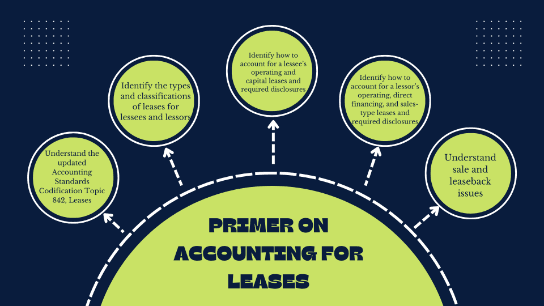
Lessor’s operating, direct financing, and sales-type leases and required disclosures.
In February 2016, the Financial Accounting Standards Board (FASB) issued Accounting Standards Update (ASU) 2016-02, Leases, which provides new guidelines that change the accounting for leasing arrangements. To properly account for leases, financial professionals must understand ASU 2016-02 (also referred to as Topic 842). This guidance covers how leases should be accounted for. Before the update, the previous leasing standard (ASC 840) had been in existence for almost 40 years.
The purpose of the new standard is to close a major accounting loophole in ASC 840 that dealt with off-balance sheet operating leases. The core principle of the new standard (Topic 842) is as follows: A lessee should recognize the assets and liabilities that arise from leases. The FASB wanted to address off-balance sheet concerns related to lessees' operating leases.
This requirement, compared with legacy lease accounting, primarily changes the accounting for lessees, requiring them to record assets and liabilities on the balance sheet for almost every lease. This significantly differs from legacy accounting for operating leases, under which they were viewed as executory contracts not recognized for accounting purposes—in other words, they were off-balance sheet.
Since the issuance of ASU 2016-02 more than five years ago, the FASB has released various ASUs to provide additional transition relief and make technical corrections and improvements to the standard.
During a public Board meeting in April 2021, the FASB staff noted that the lease modification guidance in ASC 840 and ASC 842 contemplates routine changes in terms and conditions of lease contracts negotiated between lessees and lessors, but not changes rapidly executed on a global scale as a result of the COVID-19 pandemic. Accordingly, the FASB staff stated that for concessions related to the pandemic, an entity could decide not to analyze each lease contract to determine whether enforceable rights and obligations for concessions exist. Instead, an entity can elect not to apply the lease modification guidance in ASC 842 or ASC 840 to those contracts and to account for lease concessions related to the effects of the COVID-19 pandemic as though those concessions arise from the enforceable rights and obligations of the existing contract (regardless of whether those concessions explicitly exist in the contract). The election can be made for concessions if the total cash flows required by the modified contract remain substantially the same or are less than the total cash flows before the concession. The FASB staff expects that reasonable judgment will be applied in that determination.
Most recently, the FASB issued ASU 2021-05, which changed the accounting for lessors of leases with variable payments that do not depend on an index or rate. This new guidance requires a lessor to classify a lease with any variable lease payments as an operating lease at lease commencement if both of the following conditions are met:
This amendment was designed to eliminate the possibility that an economically profitable arrangement would lead the lessor to recognize a loss at lease inception as a result of the ASC 842 measurement requirements for variable lease payments that are not based on an index or rate.
The course covers elements of lease classification for both lessees and lessors.

Lynn Fountain has over 45 years of experience spanning public accounting, corporate accounting and consulting. 24 years of her experience has been working in the areas of internal and external auditing. She is a subject matter expert in multiple fields including internal audit, ethics, fraud evaluations, Sarbanes-Oxley, enterprise risk management, governance, financial management and compliance. Ms. Fountain has held two Chief Audit Executive positions for international companies. In 2011, as the Chief Audit Executive for an international construction/ engineering firm, she was involved in the active investigation of a joint venture fraud. The investigation included work with the FBI and ultimately led to indictment of the perpetrators and recovery of $13M. Ms. Fountain is currently engaged in her own training and consulting business and is a regular trainer for the AICPA. Ms. Fountain is the author of three separate technical books. “Raise the Red Flag – The Internal Auditors Guide to Fraud Evaluations” was published by the Institute of Internal Auditors Research Foundation. -“Leading The Internal Audit Function” and -“Ethics and The Internal Auditor Political Dilemma” were published by Taylor & Francis In addition Ms. Fountain was a contributing author to the certification program exam for the National Association of Accountants. She also has certificate programs on various on-line platforms. Ms. Fountain has performed as an adjunct instructor for the School of Business for Grantham University and developed the first internal audit curriculum for the School of Business at the University of Kansas. Ms. Fountain obtained her BSBA from Pittsburg State University and her MBA from Washburn University in Kansas. She has her CGMA, CRMA credentials and CPA certificate (non-active).
