Uncover the radical central planning, dramatic upheavals, and transformative socialist policies that redefined China from the revolution to the reform era.
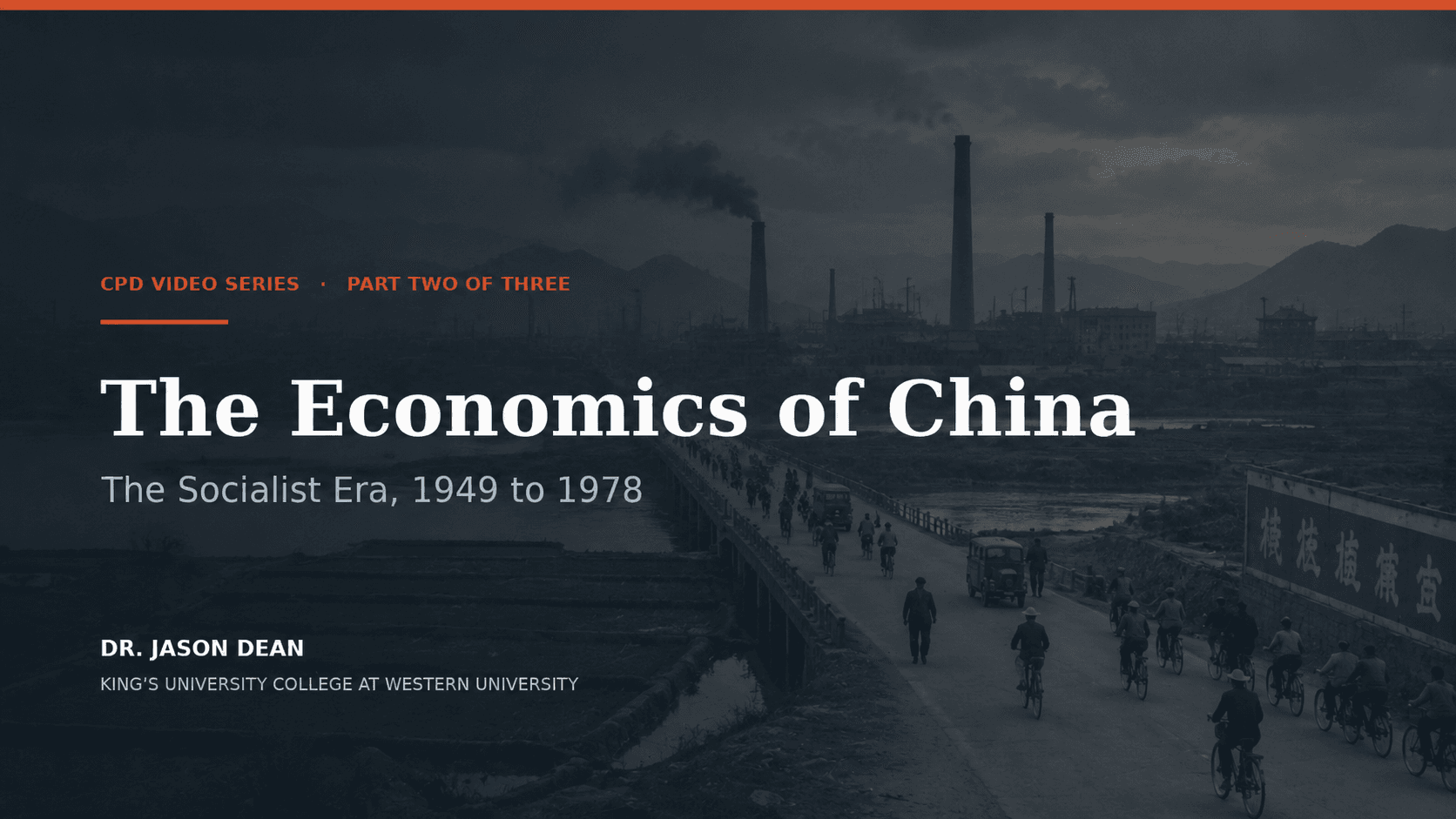
Between 1949 and 1978 China built a command economy and dismantled the mechanisms a market uses, one at a time, in a documented order. That makes the period an unusually clean test of what the first course argued in the abstract.
The hour opens in 1958 with a steel campaign that ran from thirty thousand backyard furnaces in July to ninety million people by December, producing metal no factory could use. Was it allocatively efficient. Would a market have done it. Both wait for the framework. That framework is the four changes phased in by 1956, treated not as four policies but as the removal of every mechanism a market uses to correct itself. Prices carry instructions instead of measuring scarcity. Quotas reward tonnage, then corrupt the information they rest on. Exit closes on both sides of the labor market. Land title goes to three hundred million peasants in 1950 and is taken back by 1956.
The centre is the famine of 1959 to 1961. Output fell about fifteen percent, for reasons the hour sets out, and that is not the explanation. Available food went from just over twenty-one hundred calories a day in 1957 to about fifteen hundred by 1960, serious hunger but not a level at which tens of millions die. Quotas were fixed in advance from expected output, so the share taken rose as harvests fell and the biggest growers surrendered the most exactly when their own crops failed. Famine severity rose with food production per person. The most productive regions died worst.
The close runs from the retreat of 1961 to the drift of the 1970s and ends on the investment record, where an eight percent average conceals swings from plus fifty-four to minus fifty-two and every turning point carries the name of a political campaign rather than an economic change. The failure is structural, not moral. Every mechanism would have run the same way with entirely decent people in every chair, and the comparison is never markets against an ideal government but imperfect markets against imperfect governments.
LEARNING OBJECTIVES
TARGET AUDIENCE
CPAs, lawyers, financial advisors, analysts, managers and business owners. The hour is economic reasoning worked through a fully documented case, so it suits anyone whose job involves forecasting when prices are set by policy rather than scarcity, reading figures produced by people whose targets depend on them, or judging how a rule changes behaviour once the people under it start responding to it. No background in Chinese history is assumed and none is needed.

Associate Professor of Economics | King's University College at Western
Dr. Jason Dean is an economics professor and applied economist with experience teaching macroeconomics, microeconomics, labour economics, economic history, public policy, and applied economic topics to university, college, and professional audiences. He holds a PhD in Economics from McGill University, an MA in Economics from the University of Guelph, and an Honours BBA from Wilfrid Laurier University. His academic work focuses on labour markets, immigration, housing, poverty, economic history, and public policy. He has also worked as a health economist and economic research analyst, bringing both academic and applied experience to his teaching. Jason has taught at King’s University College, Wilfrid Laurier University, Sheridan College, McMaster University Continuing Education, McGill University, Kwansei Gakuin University in Japan, Renmin University in Beijing, and Wuhan University of Technology. His courses are built to make economic ideas practical, clear, and useful for real decisions. His peer-reviewed research has appeared in journals including Regional Science and Urban Economics, Cliometrica, Journal of Housing Economics, IZA Journal of Development and Migration, Contemporary Jewry, Journal of International Migration and Integration, International Journal of Social Economics, and health economics journals. His policy work has been published through the Montreal Economic Institute, and he has provided media commentary on labour markets, housing, public policy, immigration, and the Canadian economy. Jason’s CPD courses help professionals understand how economic indicators, policy decisions, inflation, GDP, interest rates, labour markets, and consumer demand connect to business conditions, client decisions, financial planning, and the broader economy. Selected Publications: - “Income Decline, Financial Insecurity, Landlord Screening and Renter Mobility,” Regional Science and Urban Economics, 2022. - “The Linguistic Wage Gap in Québec, 1901 to 1951,” Cliometrica, 2022. - “Sexual Orientation and Homeownership in Canada,” Journal of Housing Economics, 2020. - “Does it Matter if Immigrants Work in Jobs Related to their Education?” IZA Journal of Development and Migration, 2018. - “Labour Market Attainment of Canadian Jews During the First Two Decades of the 20th Century,” Contemporary Jewry, 2017. - “Economic Integration of Pre-WWI Immigrants from the British Isles in the Canadian Labour Market,” Journal of International Migration and Integration, 2016. - “Religiosity and Female Labour Market Attainment in Canada: The Protestant Exception,” International Journal of Social Economics, 2016.
